This week, the 125th French Open has begun with the rounds of one and two being played. As a kid, I was an avid tennis fan in the era of Steffi Graf, Monica Seles and Gabriella Sabatini and tried to emulate Seles’ two-handed stroke unsuccessfully. I also attempted to copy Graf’s powerful forehand and Sabatini’s agile net play, but this clumsy teen was unable to play like her tennis idols.
The women currently competing at the Grand Slam level, such as Naomi Osaka, Serena Williams, Simona Halep, and Sofia Kenin are incredible athletics and individuals, but without the women of earlier times, we might not be seeing so much talent and strength in the women’s game. Women such as Billie Jean King, Chris Evert, and Martina Navratilova to name a few.
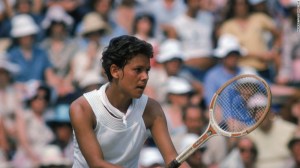
On June 3, 1972, the French Open Championship took place between two future legends of the game: Billie Jean King and Evonne Goolagong with King winning the match 6-3 6-3. This was Billie Jean King’s first and only French Open title. This would not however, be the last time Evonne Goolagong would make the French Open final in her career as she won the tournament in 1974, 1975, 1976 and 1977.
During my young obsession with tennis, the only reason I knew the name Evonne Goolagong was that my mom had a Evonne Goolagong model Dunlop tennis racket. This was a bright blue wooden racket with the thick corded string. I would scoff at this antique, comparing it to my oversized head Pete Sampras model Wilson racket, but my mom would hit some Goolagongs with that racket, firing the ball past my stubborn head.
Evonne Goolagong grew up the third of eight children in an Aboriginal family in rural Australia, the daughter of a sheep sheerer and homemaker. Despite the discrimination against Aboriginal people, she was able to play tennis due to her talent and perseverance. Goolagong faced several episodes of discrimination in her professional career as well with one incident happening in 1972 when she was asked to play in a tournament in segregated South Africa. Evonne Goolagong was classified as an “honorary white” to avoid any issues while playing in the tournament.
Due to Goolagong’s work ethic, athletic ability, and determination, she retired from the sport as one of the greatest women’s tennis players in history. She is twelfth on the women’s list of all-time singles Grand Slam winners with seven championships and has eighty-two total singles titles. Goolagong also has doubles and mixed doubles titles at the Australian and French Opens and Wimbledon. She has been inducted into the Sport Australia Hall of Fame and the International Tennis Hall of Fame. Evonne Goolagong has been made an Officer of the Order of Australia and a Companion of the Order of Australia “for eminent service to tennis as a player at the national and international level, as an ambassador, supporter and advocate for the health, education and wellbeing of young Indigenous people through participation in sport, and as a role model.”
I wish I had known who Evonne Goolagong was when I was making fun of my mom’s old wooden racket. The woman who grew up in a small rural town in Australia overcoming the obstacles of discrimination and poverty to become one of the greatest and most recognized tennis players in history. Lastly, I wish I still had the Goolagong racket as a reminder of what perseverance and determination can do.
 Time Out With Jenn & Lisa